Intraday calendars
Hourly, half-hourly and quarter-hourly data follows an intraday calendar: day-ahead power prices by hour, GB settlement periods, peak and off-peak block hours. An intraday calendar has no rules. It is every interval of the day, in its own time zone, less the hours you leave out, on the days its holiday calendar allows.
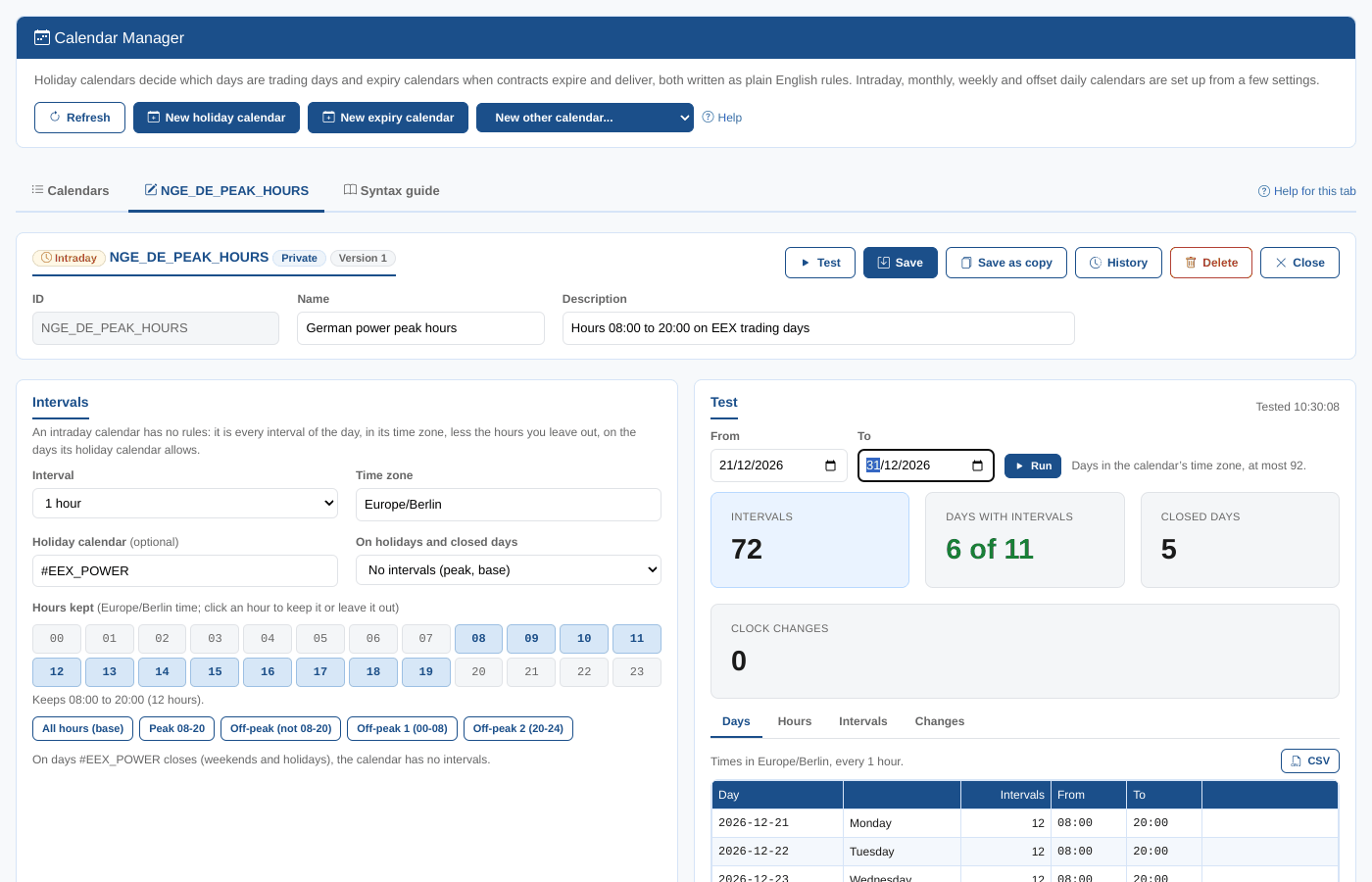
At Northgate Energy, Tom Clarke looks after the German power hour calendars: NGE_DE_PEAK_HOURS (08:00 to 20:00, Berlin time, on EEX trading days) and NGE_DE_OFFPEAK_HOURS (the other hours, and the whole of weekends and EEX holidays).
Creating an intraday calendar
Choose Intraday in the New other calendar... menu in the header. A new calendar starts as every hour of every day in UK time. Give it an ID, a Name and a Description, set the fields below and select Save.
To open one, click it on the Calendars tab: choose Intraday calendars in Type to list only them.
The definition
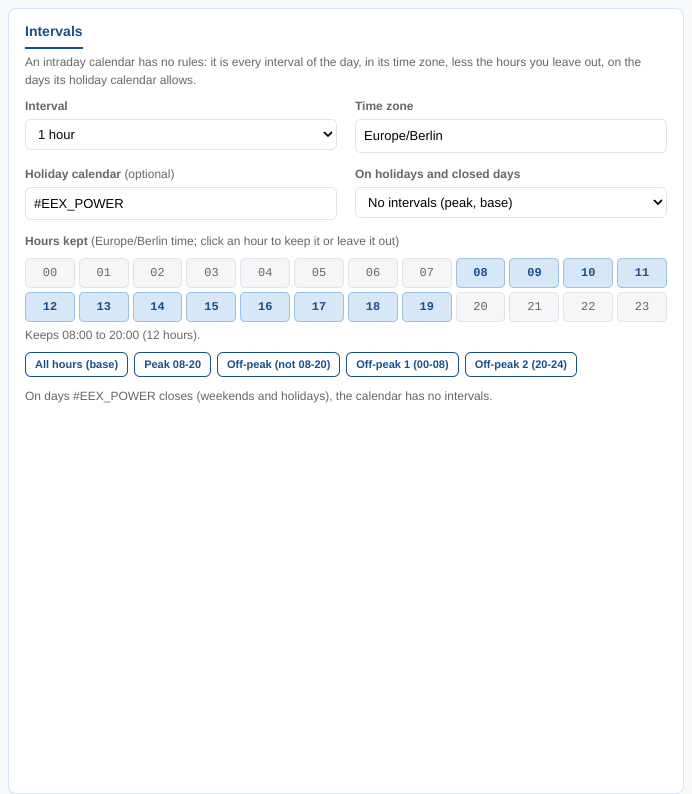
| Field | What it does |
|---|---|
| Interval | The length of each interval: 1, 5, 10, 15 or 30 minutes, or 1, 2, 3, 4, 6 or 12 hours. It must divide a day exactly. |
| Time zone | The time zone the hours are in, such as Europe/Berlin or Europe/London. Pick one from the list or type its name. The hours follow the clocks, so a day has 23 or 25 hours when they change. |
| Holiday calendar | Optional. The calendar that decides which days are open, such as #EEX_POWER or #UKBANKHOLIDAYS. Leave it empty for every day. |
| On holidays and closed days | No intervals (peak, base): the days the holiday calendar closes (weekends and holidays) have no intervals. Every interval of the day (off-peak): those days keep every interval, whatever the hours below. |
| Hours kept | Click an hour to keep it or leave it out. The hours are in the calendar's time zone: 08 is 08:00 to 09:00. The text under the hours says which ones are kept. |
The buttons under the hours set common blocks:
| Button | Hours kept |
|---|---|
| All hours (base) | 00:00 to 24:00 |
| Peak 08-20 | 08:00 to 20:00 |
| Off-peak (not 08-20) | 00:00 to 08:00 and 20:00 to 24:00 |
| Off-peak 1 (00-08) | 00:00 to 08:00 |
| Off-peak 2 (20-24) | 20:00 to 24:00 |
For an off-peak calendar, keep the off-peak hours, set the holiday calendar and choose Every interval of the day (off-peak): weekends and holidays are then off-peak all day, as the market defines them.
The platform checks the definition when you test and when you save: an interval that does not divide a day, a time zone it does not know, a holiday calendar that does not exist (or is itself intraday) and a calendar with every hour left out are refused, with the reason.
Testing an intraday calendar
The Test panel works out the intervals with the definition as it is in the editor, saved or not. From and To are days in the calendar's time zone, up to 92 days. It starts with the next seven days.
| Card | What it shows |
|---|---|
| Intervals | Intervals in the range |
| Days with intervals | Days that have at least one interval |
| Closed days | Days the holiday calendar closes. For an off-peak calendar the card is Whole days (closed days): those days are kept whole. |
| Clock changes | Days of 23 or 25 hours in the calendar's time zone |
Days
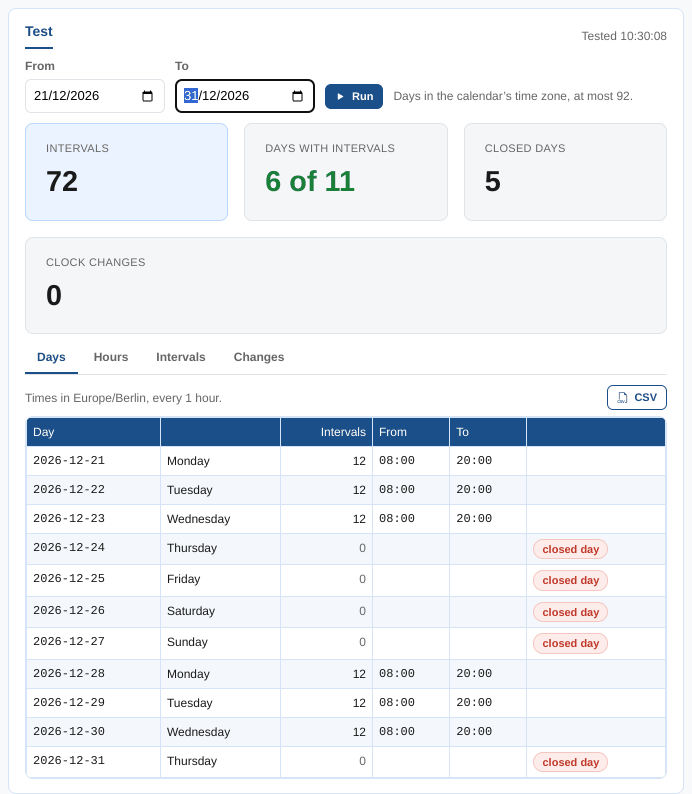
One row per day: the number of intervals, when the first starts and when the last ends, with closed day (or closed day: whole day kept) and 23 hour day or 25 hour day marks. In the example, 24 to 27 December and New Year's Eve are closed on #EEX_POWER, so the peak calendar has no hours on those days.
Hours
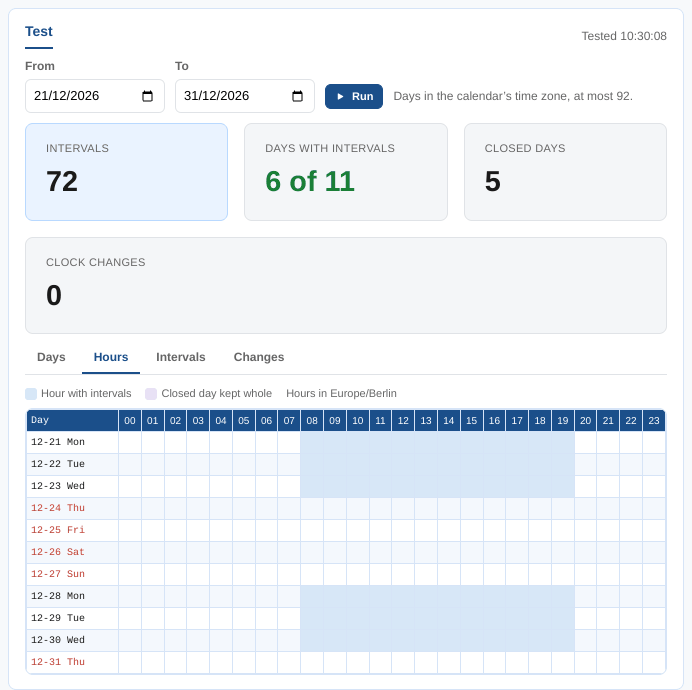
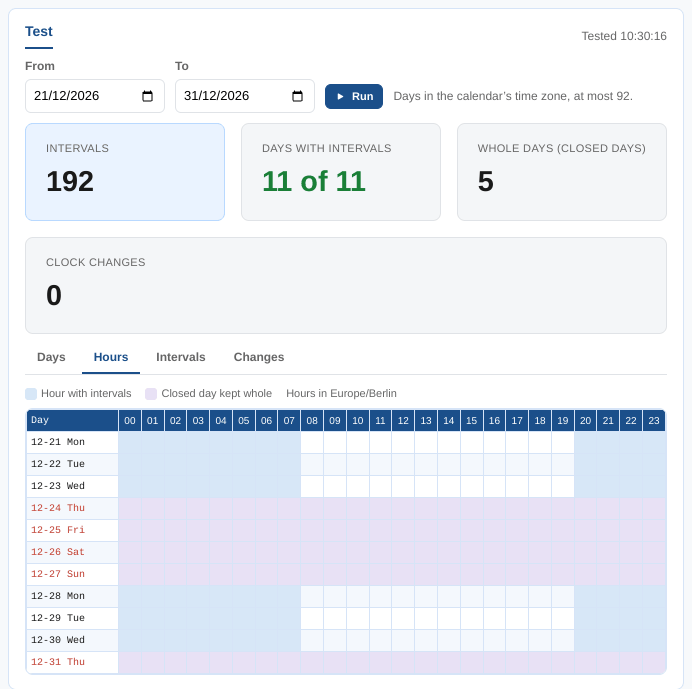
A grid of the days and the 24 hours of each, in the calendar's time zone: blue for the hours with intervals, purple for a closed day kept whole.
The off-peak calendar over the same days keeps the night hours on open days, and every hour of the closed days:
Intervals
Each interval: its local time, its offset from UTC and the time in UTC, which is how a timeseries on the calendar stores its index. At most 3,000 are listed; CSV downloads them.
Changes
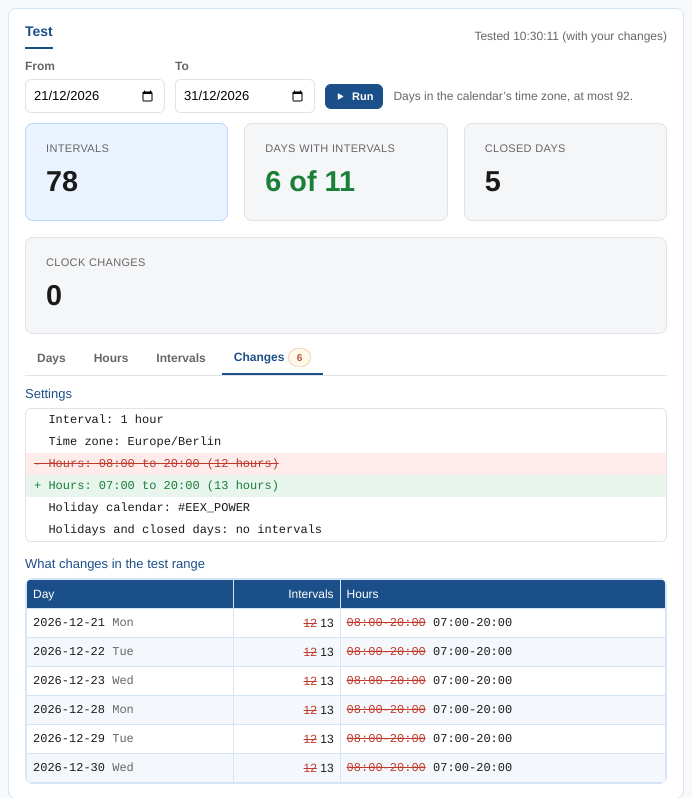
For a saved calendar: the definition against the saved version, line by line, then the days whose intervals change in the test range. At Northgate Energy, Tom tries starting peak at 07:00: the tab shows one more hour on each open day before he decides.
Public intraday calendars
Public intraday calendars, such as #EPEX_DA_OFFPEAK2_CALENDAR (the EPEX day-ahead Offpeak-2 block, 20:00 to 24:00 Paris time), can be tested but not changed. Use Save as copy to make a private version.
History
History compares the definition of any version with the editor, and Load into the editor puts it back, as for other calendars. See Editing rules.