What is Event Data?
A lot of market data arrives as events: a broker quote, a trade, a settlement price for one option strike, a meter reading. On the platform they are kept in event lists, such as NGE.POWER.DE:BROKER_QUOTES, one event per quote. Events are the raw material for curves and timeseries: an event curve takes the latest quote for each contract and turns a day's events into a forward curve, an event timeseries turns a value on each event into a series over time, and event options turn option settlements into an option chain. Event Data is the extension for working with all of it, and answers questions like:
- Which event lists do we have for German power, and what is in them?
- Which of the licensed ICE events can we see, and which list holds the TTF options?
- What did our brokers quote for the December contract last week, and how has the mid moved?
- Can I load this spreadsheet of readings as events, without writing a script?
- Can I make a forward curve from our broker quotes, and see what it gives before I save it?
- What does the TTF option chain look like today, strike by strike?
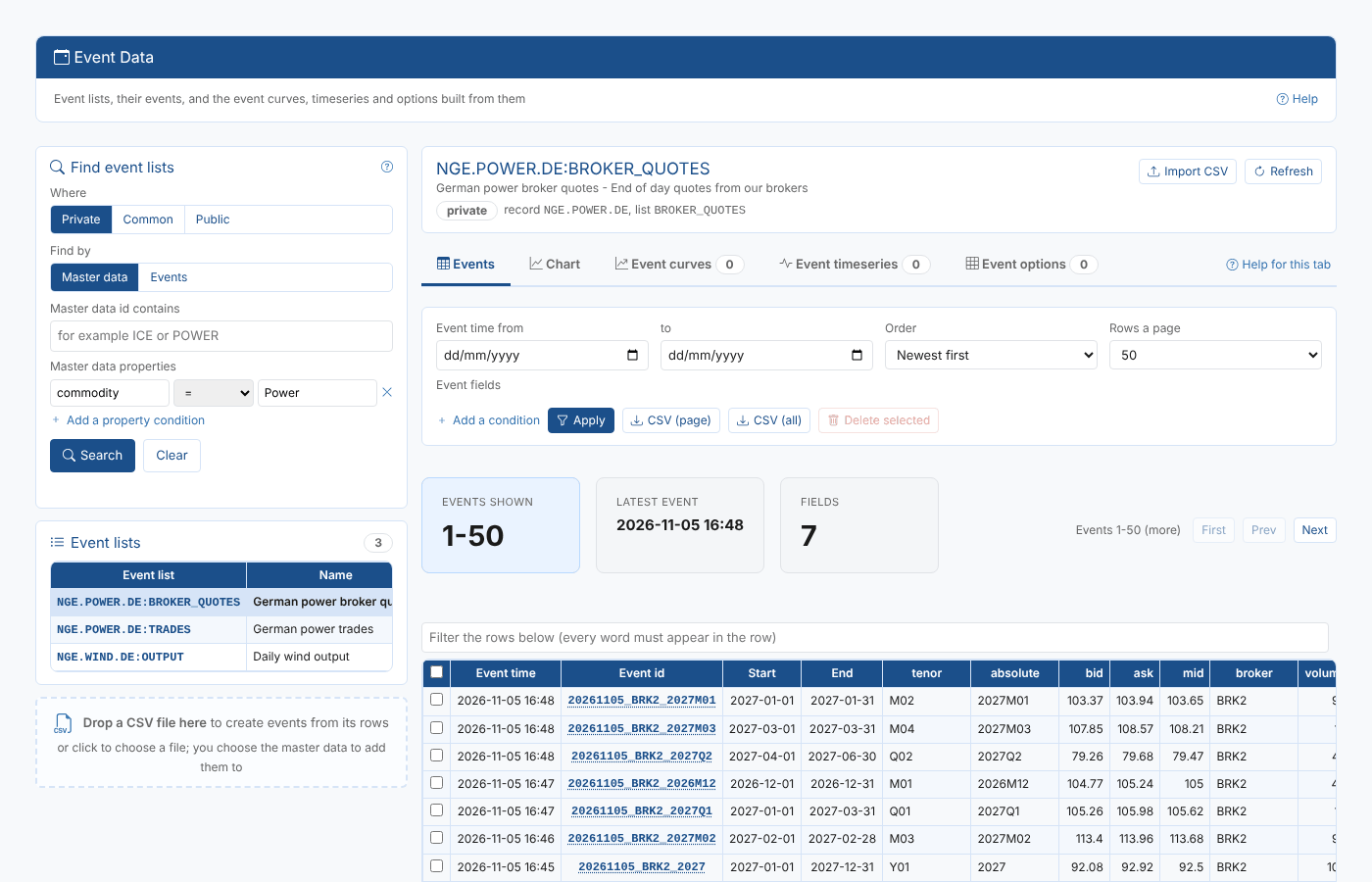
Throughout these pages we follow Northgate Energy, a fictional gas and power trader. Its market data team keeps end of day broker quotes for German power in NGE.POWER.DE:BROKER_QUOTES, the daily output of its wind farms in NGE.WIND.DE:OUTPUT, and reads the licensed ICE Endex TTF options in ICE.NDEX.EFO:OPTIONS. Priya Shah, a market data analyst, uses Event Data to check the quotes, load new readings and build curves from them.
Key ideas
| Idea | What it means |
|---|---|
| Event | One record with a time (eventtime), an optional start and end (eventstart, eventend), an id (eventid) and any fields of its own, such as absolute, bid, ask and mid. |
| Event list | The events of one kind, kept as a property of a master data record: NGE.POWER.DE:BROKER_QUOTES is the BROKER_QUOTES list on the record NGE.POWER.DE. |
| Where the events are | Events can be private (your own), public, or common: the licensed data OpenDataDSL loads for its clients, such as ICE and EEX settlements. The list itself always sits on a private or public master data record, and says where its events are. |
| Dataset id | Events loaded from a dataset carry its id in _dsid, for example ICE.NDEX_OPT.EFO for the ICE Endex TTF options. |
| Event curve | A forward curve built on the fly from the events of each day: one contract per tenor, from the value of the latest event for that tenor. |
| Event timeseries | A timeseries built from one value of each event, at its start, end or time. |
| Event options | An option chain built for each day: for each tenor, a table of strikes with call and put values. |
| Preview | What a curve, timeseries or option chain would look like, worked out in the browser from the events before you save it. |
What you get
| Screen | Where | What it is for |
|---|---|---|
| Event Data | Information menu | Find event lists in private, common and public data, look at their events, import CSV files and build from them. |
| Event Data tab | Master Data screen | The event lists on the record you are looking at, with the same tools. A CSV file dropped here goes on that record by default. |
Each open list has five tabs:
| Tab | What it shows |
|---|---|
| Events | The events, page by page, with filters, a row filter and CSV export. |
| Chart | Any number field of the events over time, with a line for each value of another field. |
| Event curves | The event curves built from the list: create, change, preview, delete, and the curves the platform builds. |
| Event timeseries | The same for event timeseries. |
| Event options | The same for option chains. |
Where next
- Finding event lists: by master data, by dataset id or event fields, and on a master data record.
- Viewing and charting events: filters, paging, CSV export and charts.
- Importing events from a CSV file: drop a file, map its columns and choose where the events go.
- Event curves: build a forward curve from broker quotes.
- Event timeseries: a daily series from wind output readings.
- Event options: the TTF option chain from the ICE events.
- Reference: how things are stored, the platform calls, and troubleshooting.